Lore · Ages & Empires
The Combine Empire
Every Combine spire you ever ported from was a ruin of an empire almost nobody remembers. Shadows of Luclin finally told us what happened to it.
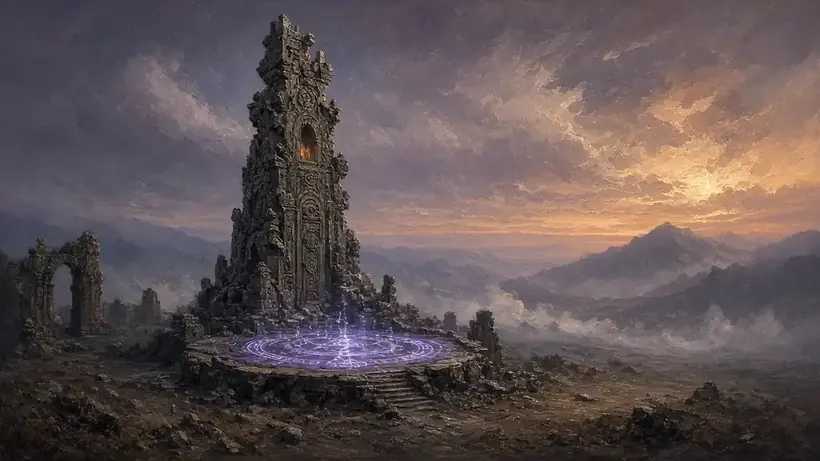
An empire with no records
While the elder races regrouped, a small band of barbarians was suddenly changed in body and mind. They became the first humans. They studied the lost art of geomancy, spread across the known world as the Combine Empire, and then died out even faster than they had grown, for reasons no one knew. Their relics and ruins are scattered from Odus to Faydwer.
By one modern reckoning the empire lasted from roughly 2460 to 2760, and in the end it splintered, most of its leaders carrying their quarrel to the moon of Luclin. The in-game history The End of the Empire, Volume I places its fateful summit in 4976 A.V., in Felwithe.
Not only human
The elven druid Aliane Rainmist, a servant of Tunare, rejects the idea that the Combine was simply a human empire. In her history it was an alliance of humans, elves, northmen, dwarves, halflings and gnomes. Under the bard Tsaph Katta no citizen had more privilege than another, and “none were above the law, and none outside it.” His most trusted minister was Seru: handsome, charming, and secretly consumed by ambition. Some excuse what Seru did next by pointing to Katta’s plans to bring the ogres of Oggok and the trolls of Innothule into the Combine.
The summit
Katta, Imperator of the troubled Combine, held a grand state banquet, the first summit to which the Teir’Dal were invited. Almost every nation sent someone: dwarves, gnomes and elves, the Teir’Dal, even ogres and trolls. His general, Seru, had grown dark and obsessive, and Katta’s advisers had barred him from seeing the Imperator alone. Katta let him come anyway.
Katta collapsed during dinner as if possessed. He had been poisoned. The later Katta Castrum account says the poison was in his goblet, and that a bard saw Seru refuse his own drink. The older Fordel Midst history tells it as a handshake from a smiling guest whose glove was dusted in empolomine, a slow, hallucination-inducing poison. Both name the poisoner: General Seru.
Katta did not die
In Rainmist’s account the poisoned emperor survived. Loyal druids held him in stasis, and the elves hid his body in their forests while his wife and chief adviser, the bard Lcea, gathered the loyalists. For more than half a century, Preservation of Beloved Katta records, the Loyalists of Katta Castrum guarded him and searched for a cure, and Seru knew his plan had failed. Seru spread lies about his death, claiming that Katta had faked it. The Buried Sea (2007) bears this out in the game: in Katta Castrum, players can climb to the top of the temple, where Tsaph Katta lies in stasis with his Head Attendant at his side, and the Katta Castrum quest reward Tsaph Katta’s Urn of Rejuvenation carries his name and a Deep Stasis effect. In Empires of Kunark (2016) Katta finally returned from the long stasis that followed his poisoning.
Two cities on the moon
Katta’s loyalists escaped to Luclin by a transportation spell, carried by the spires the wizard Grieg activated, the same Grieg the moon goddess later drove mad. When Seru learned they were gone, his rage was terrible. Instead of holding the empire together he poured everything into learning how they had escaped, and as subject peoples rose up and the empire fell into chaos behind him, his wizards cast their own version of the spell and he led his people to the moon as well.
On Luclin the Loyalists were building a great citadel in the Tenebrous Mountains. Seru’s Inquisitors, weary, short of supplies and trapped, realised they could not yet win, and built a perfectly geometric city of their own, which their leader named, with typical modesty, Sanctus Seru.
The Circle of Light
Not everyone escaped. One fragment from the end of the Combine era tells of the Inquisition sweeping out again after Katta’s fall and attacking a band of enchanters called the Circle of Light. None of the Circle survived, but they held the Inquisition back long enough for their loved ones to flee, and their descendants divided the enchanters’ tomes so that every family would keep proof of their sacrifice.
Where it fits in time
The Combine belongs to the Lost Age, “when the Humans were clearly established,” as Jindrack put it in 2008, not to the Age of Blood. And it did not fall unforeseen. In EverQuest II’s The Wheel of Time, the elf Aataltaal remembers foreseeing the empire’s fall, and blames himself for not understanding his own visions.
Sources
[1] EverQuest.com: From the Library of Norrath: Creation of Norrath (2007) · [2] EverQuest Archives: The Creation of Norrath · [3] Allakhazam: Combine Empire · [4] Library of Erudin: “The History of Norrath” (original EverQuest manual text) · [5] Library of Erudin: Combine Empire · [6] Library of Erudin: Luclin (The Birth of Fordel Midst) · [7] Library of Erudin: General Seru · [8] Library of Erudin: Tsaph Katta · [9] Library of Erudin: Lord Inquisitor Seru · [10] Library of Erudin: Combine Loyalists · [11] Allakhazam: Luclin · [12] EverQuest.com: Empires of Kunark Preview, Lore (2016) · [13] Allakhazam: Tsaph Katta’s Urn of Rejuvenation (The Buried Sea)
Official lore: 2 of 13 sources from everquest.com · How we source
Related stories
Norrath 1999 is free and always will be. If these stories brought back a memory, you can help keep the archive free on Ko-fi.
Retold in our own words from the sources listed on this page; short quotes are marked and sourced. The illustration is an original AI-generated painting made for this page alone, not from the game.